Jasmine’s first vision board died the day her roommate walked in.
“What’s that?” her roommate asked, pointing at a collage of book covers, cozy cabins, and a slightly-too-handsome actor who looked suspiciously like Jasmine’s office crush.
“It’s… nothing,” Jasmine said, yanking the board off the wall and shoving it into the closet. That night, she googled “vision boards,” closed every tab, and decided maybe this whole thing wasn’t for her.
The real problem wasn’t the vision board. It was where it lived - and who could see it.
Why Some Dreams Need Privacy
There are goals you’re happy to announce - “I’m training for a 10K!” - and then there are the quieter ones:
- “I want to leave this relationship if it doesn’t change.”
- “I wish I had the courage to apply to that program.”
- “I’m not sure I want the life everyone expects from me.”
Putting those on a poster in the living room? Hard pass.
Jasmine realized she didn’t want to stop visualizing. She just wanted a space that felt like a private journal, not a Pinterest board for public consumption. That’s when she tried building a solo board in LunaBoard and keeping it just for herself.
Step 1: Create a Board With a Name Only You Understand
Instead of calling it “Vision Board” or “Dream Life,” Jasmine titled her board “Studio Project.” If someone glanced over her shoulder, it looked like a work thing.
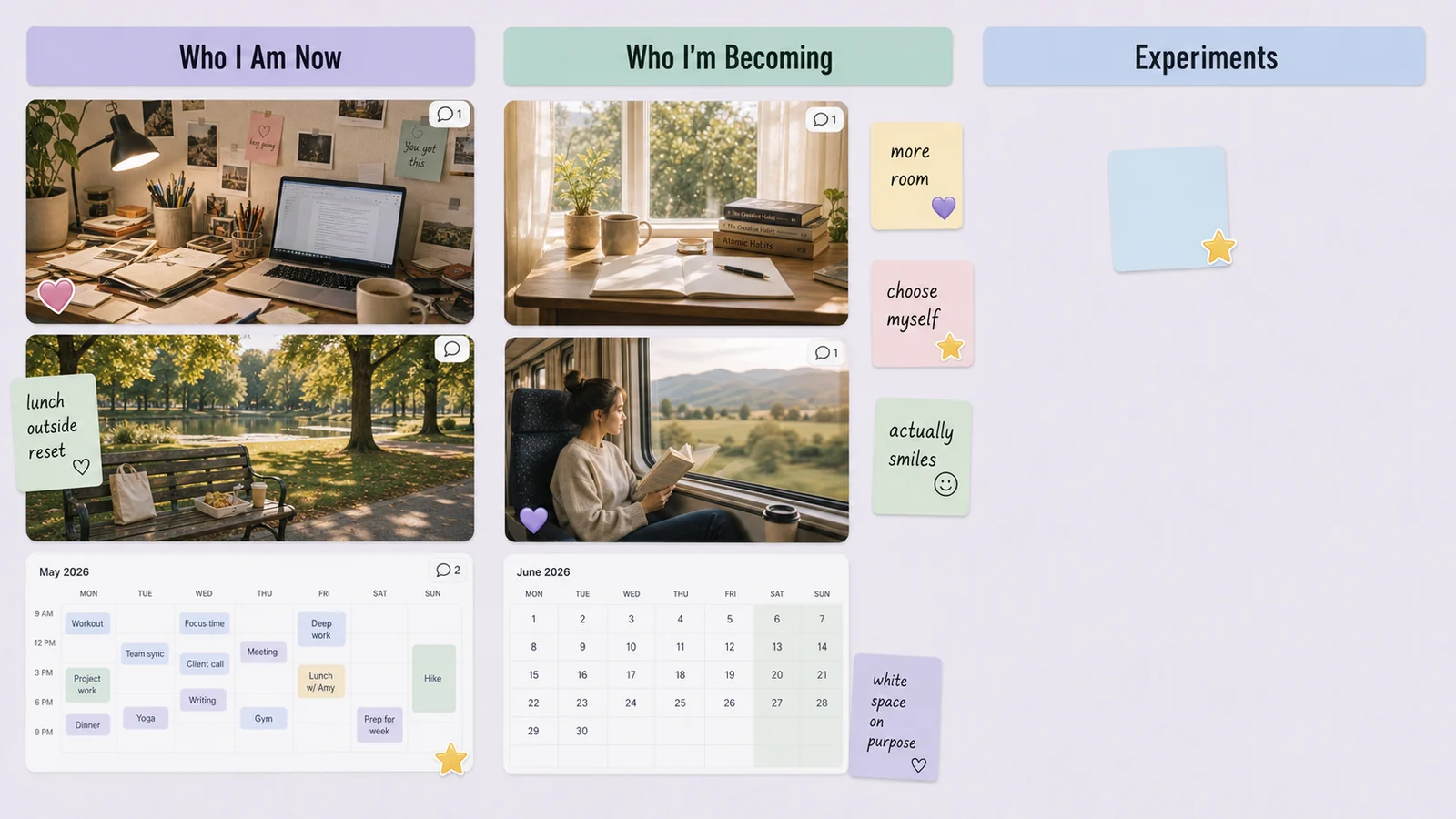
Inside, she set up three simple zones:
- “Who I Am Now”
- “Who I’m Becoming”
- “Experiments”
In “Who I Am Now,” she dropped a few current photos: her messy but beloved desk, the park bench where she ate lunch, a screenshot of her calendar crammed with meetings. In “Who I’m Becoming,” she added images that made her exhale: a sunlit writing nook, a calendar with white space, a woman reading on a train alone.
“Experiments” stayed mostly empty, on purpose. It was a promise to future-her.
Step 2: Use Text and Voice for the Stuff You Don’t Want Anyone Reading Over Your Shoulder
Jasmine didn’t want to type her rawest thoughts in giant text blocks. So she used smaller text and voice notes.
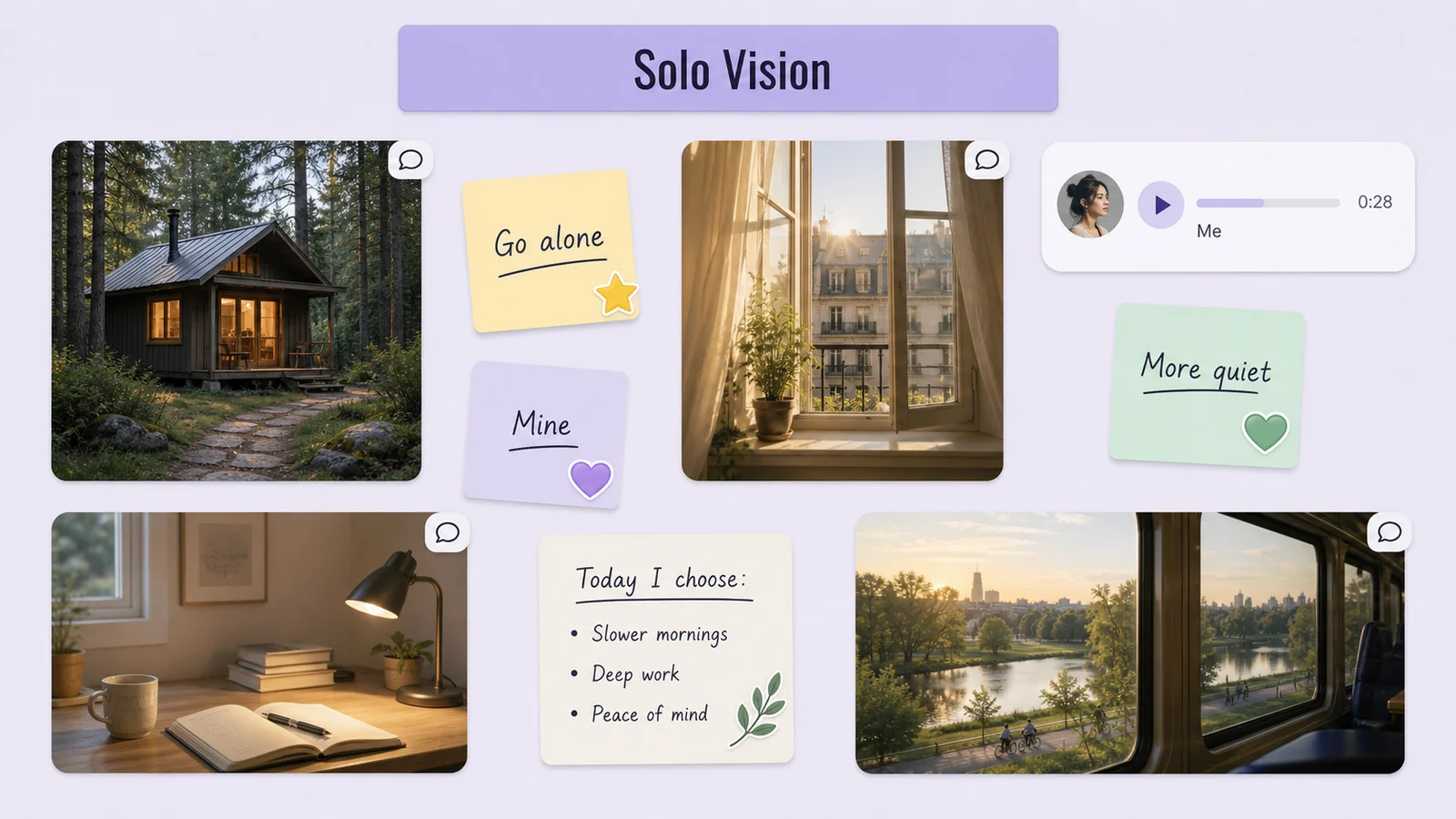
On a tiny sticky note tucked next to a photo of a writing retreat, she wrote: “I want to go here alone, even if everyone thinks it’s weird.”
Then she left herself a 15-second voice memo over a picture of an apartment with big windows: “I don’t need approval to want this. I’m allowed to want a home that feels like mine.”
No one else ever had to hear it. But she did.
Step 3: Keep It Visually Gentle, Not Perfection-Level “Inspo”
Because no one else was going to see it, Jasmine let go of making her board “aesthetic.”
Some of the images were cropped weird. Some clashed. A few were simple screenshots, not high-res anything. But together, they felt like the inside of her head - which was the whole point.
To make the board feel calmer, she:
- Chose a soft background color
- Used one simple font for all her notes
- Added small, meaningful stickers (a star next to “non-negotiables,” a heart next to “actually makes me smile”)
It wasn’t made to impress anyone. It was made to support her.
Step 4: Build a Ritual That’s Just Between You and You
Once a week, usually with tea and a face mask on, Jasmine opened her board and asked herself two questions:
- “What surprised me about myself this week?”
- “Does anything on here not fit anymore?”
Sometimes the answer was tiny - like realizing she actually loved city life more than she’d admitted. Other times, it was bigger, like noticing the relationship section felt… blank.
She didn’t rush to change her life. She just adjusted the board first:
- She removed a couple image-versions of the “perfect couple” she’d copied from Instagram.
- She added a picture of a woman laughing with friends at a long table.
- She scribbled “More of this, please” in the corner.
Her vision shifted quietly, before anything changed on the outside.
Frequently Asked Questions
Can a vision board still “work” if no one ever sees it?
Absolutely. A vision board isn’t a performance; it’s a mirror. Keeping it private can make you more honest, which tends to make it more effective. The point is not who sees it - it’s how clearly it reflects what you actually want.
How do I keep my digital vision board truly private?
Use a tool where you control sharing. In LunaBoard, you can keep a board just for yourself and only invite collaborators if and when you’re ready. You can also give it a neutral title, so even if someone glimpses the tab name, they won’t know what it is.
What if my dreams change and I feel embarrassed by old versions?
That’s normal. Instead of deleting everything, consider creating an “Archive” area on the same board or duplicating the board and marking it with the year. Looking back later can be surprisingly affirming - you’ll see how far you’ve come.
I’m not used to talking to myself kindly. How do I write or record notes without cringing?
Start small. You don’t have to write epic affirmations. Try things like “I handled that better than last time,” or “This still matters to me.” Over time, your board becomes a record of how your inner voice is softening.
Conclusion & Gentle Next Step
Jasmine’s roommate never saw her new vision board. No one ever “liked” it. But in the quiet, week after week, it nudged her toward the life she kept saying she wanted - more space, more solitude, more work that felt like her.
If some of your dreams feel too tender for the group chat, give them a home that’s just for you. Open a private board in LunaBoard, call it whatever you want, and let it be messy, honest, and entirely yours.