Mia’s TikTok was full of couples doing “vision board nights” with candles and matching sweatshirts. It looked cute. It also looked like emotional landmines waiting to happen.
Because in real life, when she and Andre talked about the future, it often ended in:
- “You always change the subject when I mention kids.”
- “You act like I don’t care about our future just because I don’t want to move tomorrow.”
So when she suggested they try a shared vision board, Andre half-joked, “Is this a test?” She surprised them both by answering, “No. It’s a way to see what’s in our heads without interrupting each other.”
Step 1: Start With “You & Me,” Not “Five-Year Plan”
They created a board called “Us, Right Now & Next.”
Before adding images, they each got 10 minutes alone with the board while the other left the room. Their only job was to add words and pictures that answered two questions:
- “What do I love about our life now?”
- “What do I want more of with you?”
Mia added:
- A photo of their Sunday pancake ritual
- A picture of a home office, labeled “more focused work time for us both”
- A tiny image of a sleeping baby (she almost deleted it twice)
Andre added:
- A beach at sunset with “annual unplugged trip?”
- A simple apartment balcony with plants
- A screenshot of a joint savings account screen (empty, but ready)
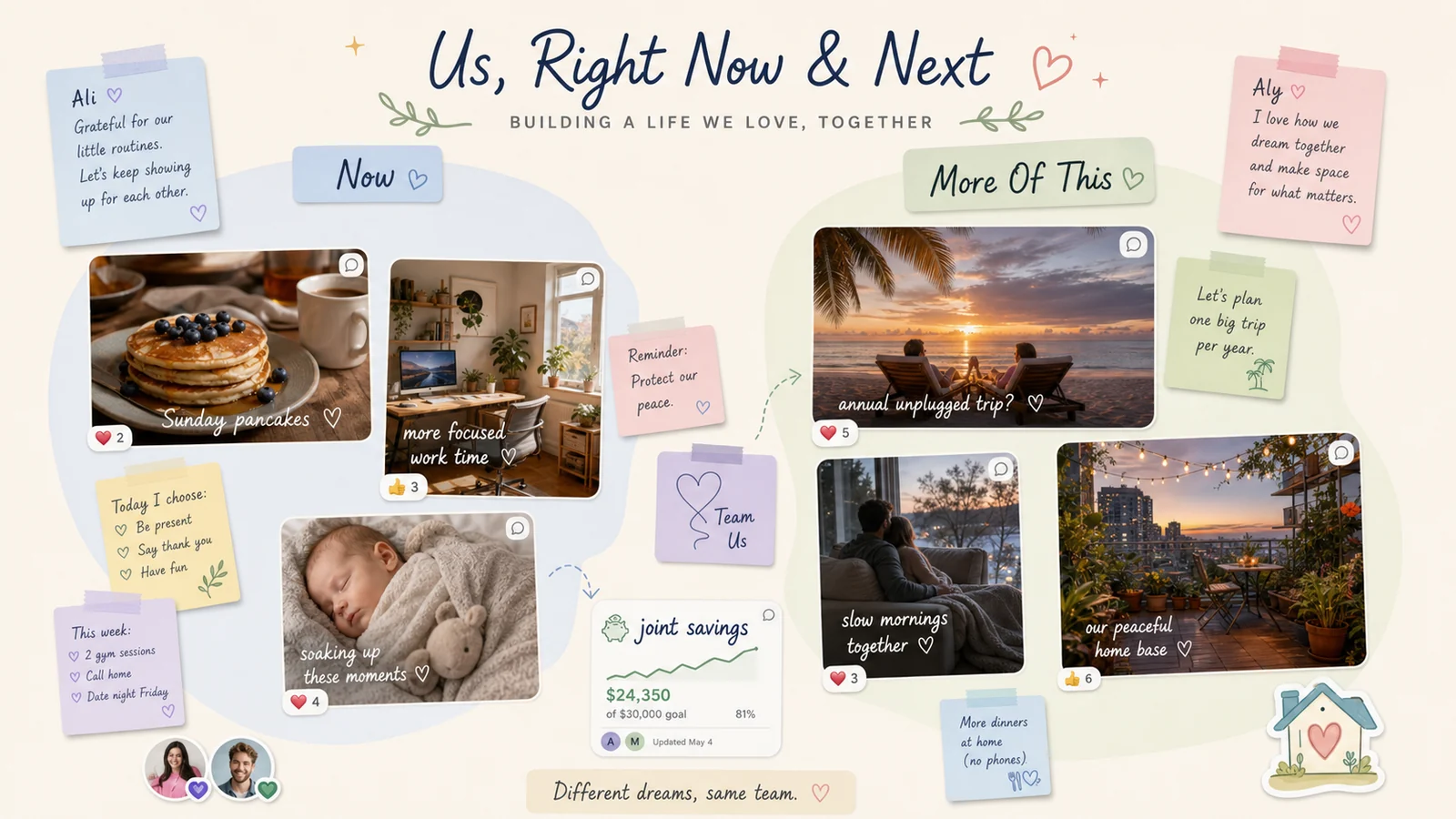
Seeing those side by side softened both of them. Clearly, they weren’t on separate planets.
Step 2: Create “Parking Lots” for the Spicy Topics
Instead of diving straight into marriage, kids, and moving cities, they made two “parking lot” areas:
- “Big Questions We’re Not Solving Today”
- “Stuff We Need More Info On”
Under “Big Questions,” they dropped:
- A picture of a house with a yard
- A pregnancy announcement photo
- A map with pins in two different cities
Under “Stuff We Need More Info On,” they added:
- A screenshot of childcare costs in their area
- Average rents vs. mortgages
- A text block: “What remote work options actually exist in my field?”
The rule was: they could add comments, questions, or resources in those zones - but no decisions. Not yet.
It took the fuse out of the topics that usually exploded.
Step 3: Use Comments and Reactions Instead of Talking Over Each Other
They agreed on something radical: for the first week, they would only “talk” about the board on the board.
That meant:
- Leaving comments under images like: “This version of a house feels more ‘us’ than the big one you pinned earlier. Can we unpack why?”
- Using reactions as gentle signals: ❤️ for “I’m excited about this,” 👀 for “I’m unsure,” and 🚩 for “this makes me anxious.”
When Mia saw Andre put ❤️ on the baby photo but 🚩 on the city move, it rewrote a story she’d been telling herself: he wasn’t anti-family; he was overwhelmed by logistics.
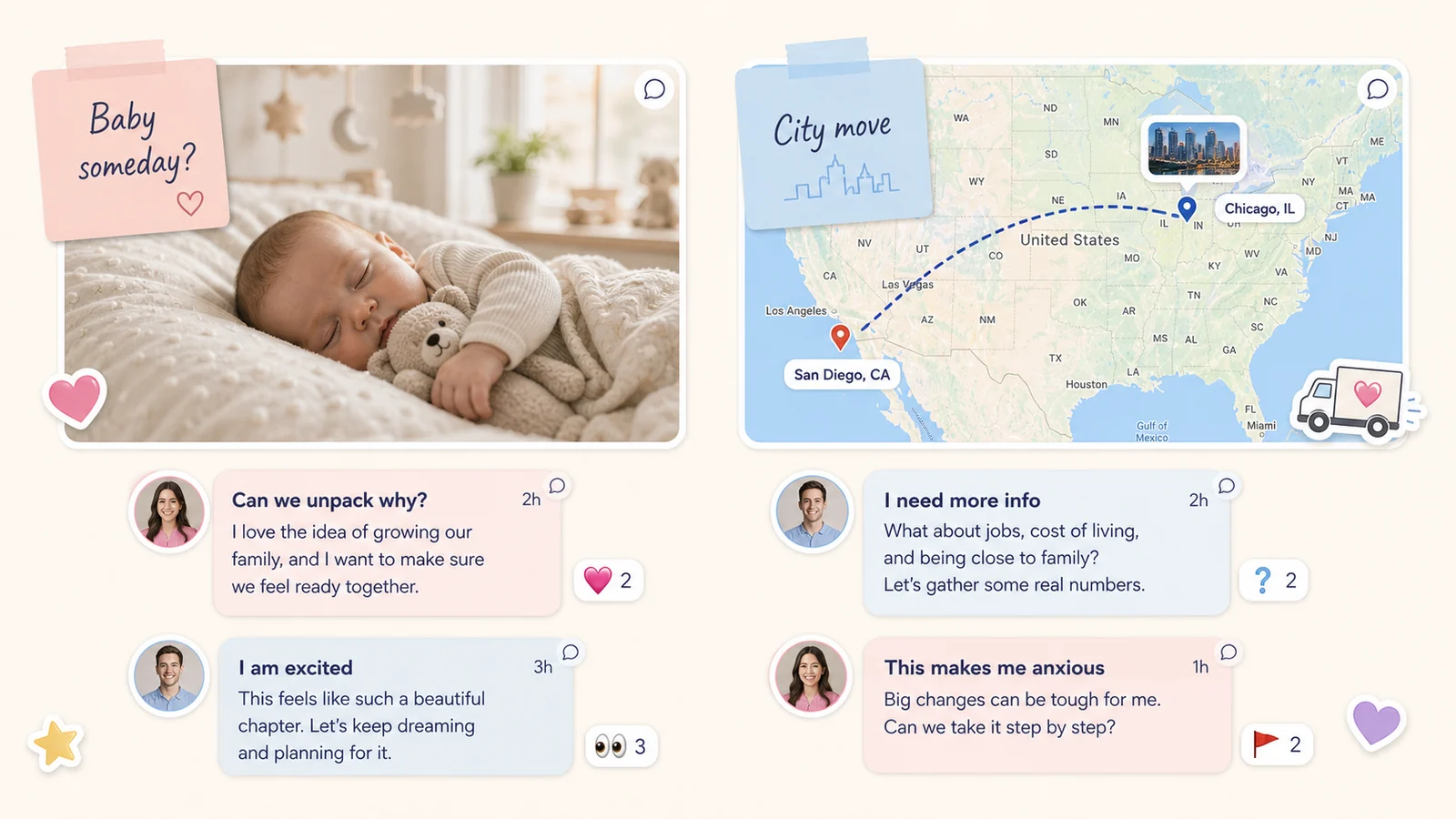
When they finally did talk face-to-face, they weren’t starting from scratch. They had a record of what they’d already said - without interruption.
Step 4: Design “We” Goals That Still Respect “I” Goals
One of their biggest breakthroughs came when they added two columns:
- “Our Goals”
- “My Goals (Mia)” and “My Goals (Andre)”
Under “Our Goals,” they put:
- “Take one unplugged trip together every year”
- “Build a 3-month emergency fund”
- “Keep Sunday pancake mornings sacred unless we’re literally out of town”
Under the “My Goals” spaces, they each added:
- Career, creative, and personal dreams that didn’t require couple consensus
- A note: “You don’t have to be excited about this for me to pursue it.”
Seeing “We” and “I” side by side calmed a lot of hidden resentment. They didn’t have to agree on everything to support each other.
Step 5: Revisit Without Turning It Into a Performance Review
Once a month, they had a “Board & Burritos” night. No candles, no pressure. Just food, the board, and two questions:
- “What did we do this month that lines up with this?”
- “Is anything on here quietly stressing one of us out?”
Sometimes that meant shrinking images that felt too intense. Sometimes it meant adding a new, smaller step - like “research therapy options” instead of “fix all our communication issues.”
The board stopped being a test and started being a shared journal of where they were headed - together and separately.
Frequently Asked Questions
What is a couples vision board?
It’s a shared visual space where both partners add images, words, and links about their current life and future hopes. Instead of arguing in abstract terms, you’re looking at a collage of what each of you actually means by “settling down,” “adventure,” or “stability.”
How do we avoid turning the board into a pressure cooker?
Set ground rules. For example: some areas are just for exploration (no decisions), reactions are invitations to talk - not verdicts - and both partners can have “My Goals” sections that don’t require negotiation.
What if one partner is more into this than the other?
That’s okay. The more-enthusiastic partner can set up the board and invite the other to add just a few images or comments at first. Keep sessions short and low-stakes. Over time, even skeptical partners often appreciate having one calm place to process big topics.
Can we use LunaBoard for both fun and serious stuff?
Definitely. Mix “heavy” clusters (money, moving, kids) with light ones (date night ideas, trips, home projects). Add stickers, inside jokes, and voice notes. It’s your relationship - you get to make the board feel like you two, not a counseling worksheet.
Conclusion & Gentle Next Step
Mia and Andre didn’t fix everything with a board. They still disagreed. They still had hard days. But now, when they said “our future,” they were pointing at the same picture - one they were editing together.
If talking about big life decisions always seems to go sideways, try changing the format. Start a couples vision board on LunaBoard, set a few kind rules, and let your dreams live somewhere you can both see them without raising your voices.